




La Palma, Peru - Organic
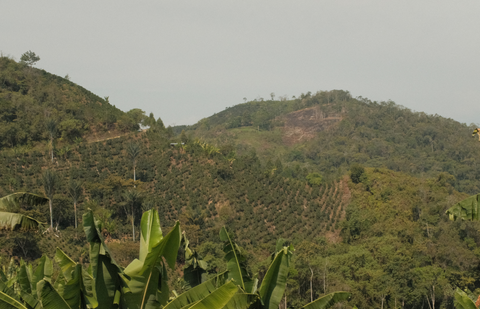
Roaster’s notes: High altitudes, ideal climates, and nutrient-rich soil make the Cajamarca region an ideal place to grow high quality coffee.
Flavour notes of sweet biscuit, rich cacao nibs with honey sweetness leading into a lingering caramel finish, honeydew notes emerge as the cup cools.
Roast Style: Light Medium
Varietals: Pache & Bourbon
Processing: Fully Washed
Altitude: 1,800 - 1,900 metres above sea level
Farm: La Palma
Region: Cajamarca
Owner: Segundo Coronado
Product information
High altitudes, ideal climates, and nutrient-rich soil in the Cajamarca region of Peru make it an ideal place
to grow high quality coffee. Our exporting partner in Peru, Alpes Andinos, work closely with many producers
throughout Cajamarca, one of which is Segundo Coronado.
Segundo has been Vice President of the Alpes Andinos association since 2019. From the start, producers
belonging to the association have benefited greatly, as not only can members receive a higher price for
quality products but also can attend training sessions on topics such as how to make products but more
productive. This drive to develop better coffee is one promoted by the association, believing that producing
great quality, leads to producer empowerment and wider benefits for all coffee families.
In this region, farmers work in 15-year rotations, focusing on each variety individually. When a plant reaches
the end of its 15-year life cycle, it will be dramatically cut back using the ‘Zoca’ practice. This sees the tree
cut back to the stem just 30 centimetres from the ground, stimulating the emergence of new growth. In
preparation for this event, trees of the same variety are planted two years in advance, meaning there is an
uninterrupted supply of mature cherry.
Soil analysis is regularly conducted with organic fertiliser applied in March and after the harvest in November.
For Fertiliser, producers in this region use a mix of compost and ‘guano de las Islas’, meaning guano from the
islands. Located just off the coast of Peru are a collection of small islands, home to large sea bird populations.
These birds produce large amounts of excrement, or, guano, which settles on the ground as a nutrient-rich
top layer. Guano is collected on the island and transported to the mainland to be used as a fertiliser.
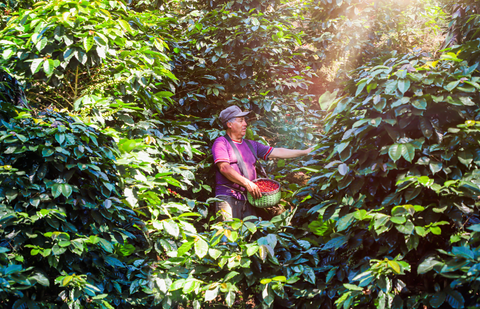
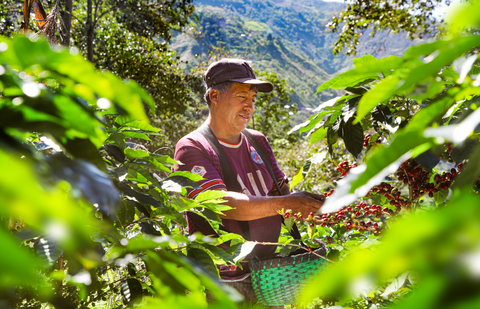
Harvest spans from July to November. Coffee processing techniques in the region are tried and tested
methods of production, often passed down through the generations. For La Palma, harvest begins with the
cherries being selectively handpicked, before being floated in cool clean water to remove any low-density
cherries. Once complete, the cherries are pulped via machine to remove the external fruit. After this step,
the coffee is fermented once more for 48 – 96 hours to break down the remaining mucilage. Then the coffee
is washed three times and dispersed on raised beds in greenhouses to dry for 15 – 20 days depending on the
climate. The coffee is then transported to Jaen, the headquarters for Alpes Andinos, to be hulled and
prepared for export. This is typically a three-hour journey.